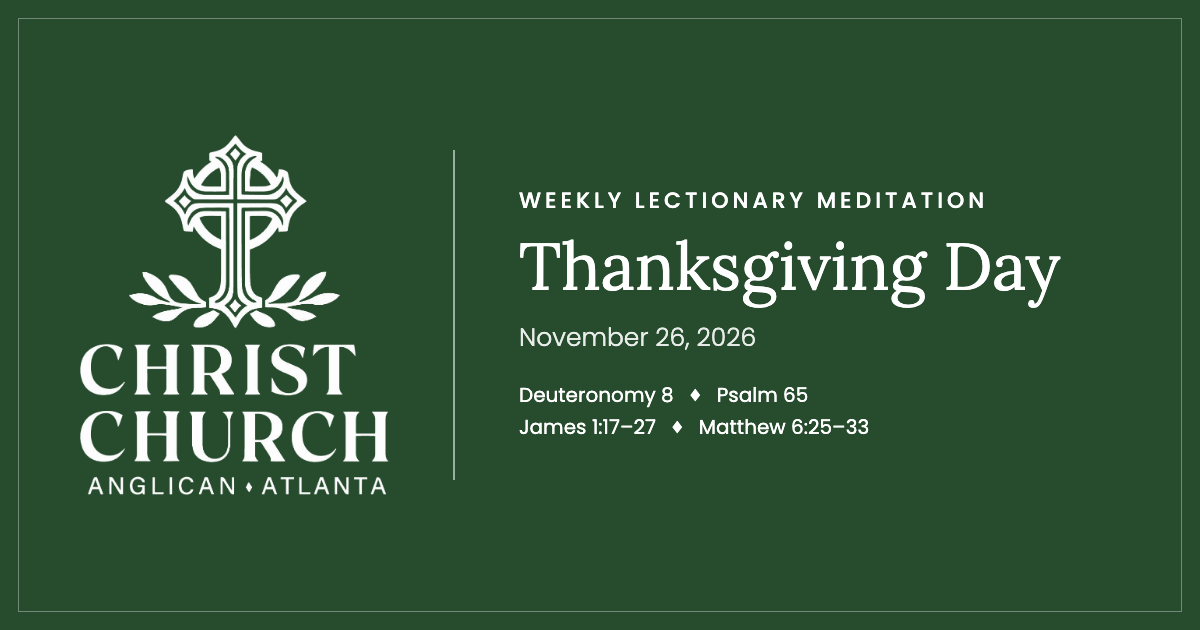
For the past several weeks I have written a weekly meditation on the Lectionary readings for the upcoming Sunday. However, this week I thought I would do something different. Instead of the lectionary readings, I wrote a brief reflection on Thanksgiving, particularly where it intersects with the history of Anglicanism in America.
You may or may not know that the Anglican Church has a long history. Legends claim that after Jesus’ Resurrection, Joseph of Arimathea sailed to the island of England and established the first Christian church in Glastonbury, England. Now, whether that expedition happened or not, many centuries later, we do know that another sailing expedition took place.
Not to England, but from England to the new world of “America”.
Now, most of us were rightly taught in grade school about how the first Congregationalist pilgrims in Plymouth, New England celebrated Thanksgiving in 1621. However, what far fewer Americans are aware of is the fact that this is not technically the first officially appointed day of thanksgiving in American history!
Two years earlier, Anglican Christians in Virginia celebrated a religious service of prayer in December of 1619. As Anglicans, these Virginian settlers would have celebrated America’s first yearly day of thanksgiving following the Book of Common Prayer.
As history moved forward, and the 13 colonies declared their independence, the Anglican Christians in places like Virginia and the Carolinas could no longer have King George III as the Supreme Governor of their church. This led the Anglican Christians in America to organize as the Protestant Episcopal Church in the United States of America in the 1780s.
Being a newly organized church, this Protestant Episcopal Church in the United States needed its own prayer book. The new American prayer book would be published in 1789 with changes. No longer would the suffrage prayer ask God to “save the King”. Instead, the American Anglicans would pray, “O Lord, bless and preserve these United States.”
In that same year (1789), George Washington proclaimed the first national Thanksgiving to be set on Thursday, November 26, 1789. And the first American prayer book of 1789 added “A Form of Prayer and Thanksgiving to Almighty God, for the Fruits of the Earth” to be prayed “on such other day as shall be appointed by the Civil Authority.”
While the American prayer book has undergone revisions over the years, our most recent prayer book (The Book of Common Prayer 2019) has maintained a form of prayer for Thanksgiving Day.
This means that the prayer book offers us direction for how we ought to thank God for what He has given to us as American Anglicans.
The Collect for Thanksgiving Day reads as follows:
Most merciful Father, we humbly thank you for all your gifts so freely bestowed upon us: for life and health and safety, for strength to work and leisure to rest, for all that is beautiful in creation and in human life; but above all we thank you for our spiritual mercies in Christ Jesus our Lord; who with you and the Holy Spirit lives and reigns, one God, for ever and ever. Amen.
The Lessons that would be read at a service of Holy Communion on Thanksgiving Day are: Deuteronomy 8, Psalm 65, James 1:17-27, and Matthew 6:25-33.
Deuteronomy 8 is a passage reminding Israel, who is about to follow Joshua into the Promised Land after forty years in the wilderness, that all their blessings come from God. They should not forget that it was God who redeemed them from Egypt, who fed them in the wilderness with manna, and who gave them the Promised Land. In verses 7-10 Moses writes the following:
For the LORD your God is bringing you into a good land, a land of brooks of water, of fountains and springs, that flow out of valleys and hills; a land of wheat and barley, of vines and fig trees and pomegranates, a land of olive oil and honey; a land in which you will eat bread without scarcity, in which you will lack nothing; a land whose stones are iron and out of whose hills you can dig copper. When you have eaten and are full, then you shall bless the LORD your God for the good land which He has given you.
Deuteronomy 8:7-10
Israel had received great blessings from God. Therefore they were to “bless the LORD [their] God for the good land which He [had] given [them].”
Psalm 65 is a psalm that exalts God for his forgiveness and provision. David knows that his iniquities prevail against him, but he trusts that God will atone for the transgressions of His people (v. 3). The psalm declares that God is the confidence of all the earth (v. 5). He has established the mountains by His strength (v. 6) and waters the earth to provide grain and to bless the growth of the earth (vv. 9-10).
The psalm concludes with imagery that evokes thankfulness to God for His abundant provision for His creation. Imagery that should fill our minds each Thanksgiving, as we consider all that the Lord has given us that we are to be thankful for.
You crown the year with Your goodness,
And Your paths drop with abundance.
They drop on the pastures of the wilderness,
And the little hills rejoice on every side.
The pastures are clothed with flocks;
The valleys also are covered with grain;
They shout for joy, they also sing.
Psalm 65:11-13
James 1:17 reminds us that “Every good gift and every perfect gift is from above, and comes down from the Father of lights, with whom there is no variation or shadow of turning.” Everything we have comes from God. He is the giver of all good gifts. But the rest of the reading (vv. 18-27) reminds us that God’s generosity should lead us to faithfulness. We should not only be hearers of God’s word, we should be doers of the word.
And we are reminded what it looks like to be a “doer of the word” from the Gospel reading in Matthew 6:25-33. These verses come from Jesus’ Sermon on the Mount where He teaches His disciples that they are not to worry or fear about their lives. But Jesus doesn’t simply command His disciples to not worry, He explains to them why their lives can be free from fear and worry by teaching:
Look at the birds of the air, for they neither sow nor reap nor gather into barns; yet your heavenly Father feeds them. Are you not of more value than they?…Consider the lilies of the field, how they grow: they neither toil nor spin; and yet I say to you that even Solomon in all his glory was not arrayed like one of these…Your heavenly Father knows that you need all these things. But seek first the kingdom of God and His righteousness, and all these things shall be added to you.
Matthew 6:26, 28-29, 32-33
As we all set aside a day of Thanksgiving, let us heed what we are reminded in God’s word. All that we have to be thankful for has come to us as a gift from God. Let us then bless the Lord for the good which He has given us, especially our spiritual mercies in Christ Jesus our Lord.
Happy Thanksgiving!
I look forward to worshiping with you this Sunday, the First Sunday of Advent.
In Christ,
Deacon Michael